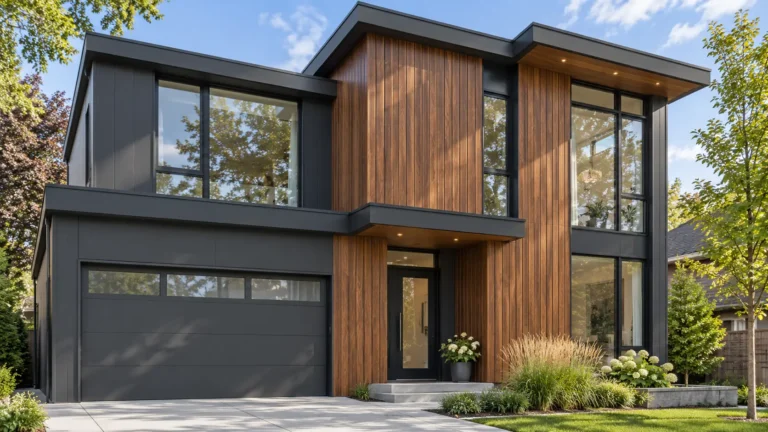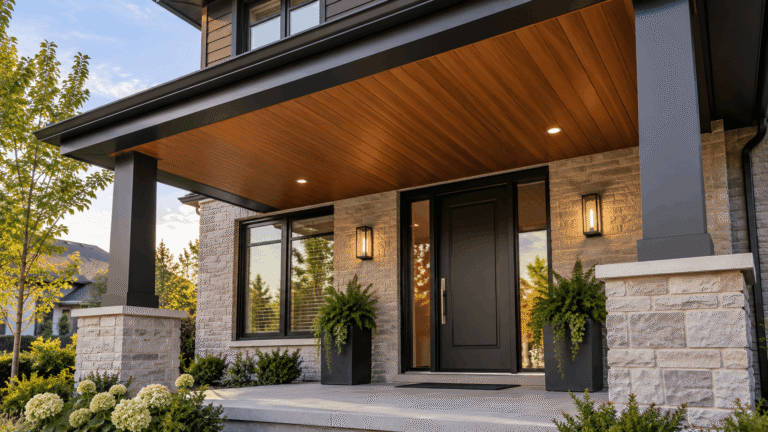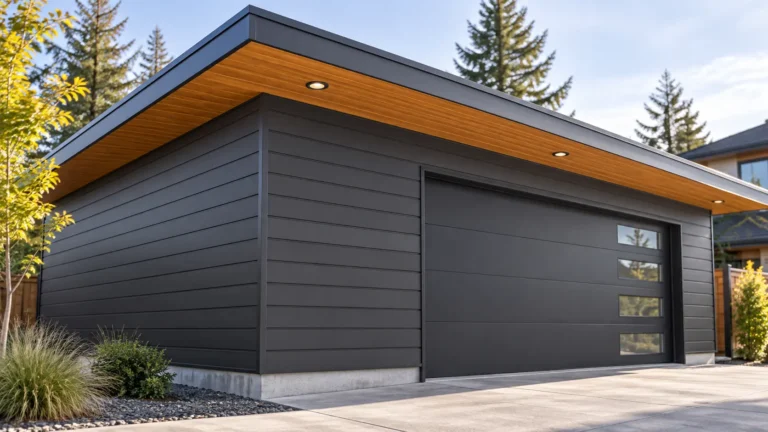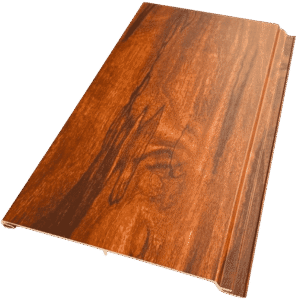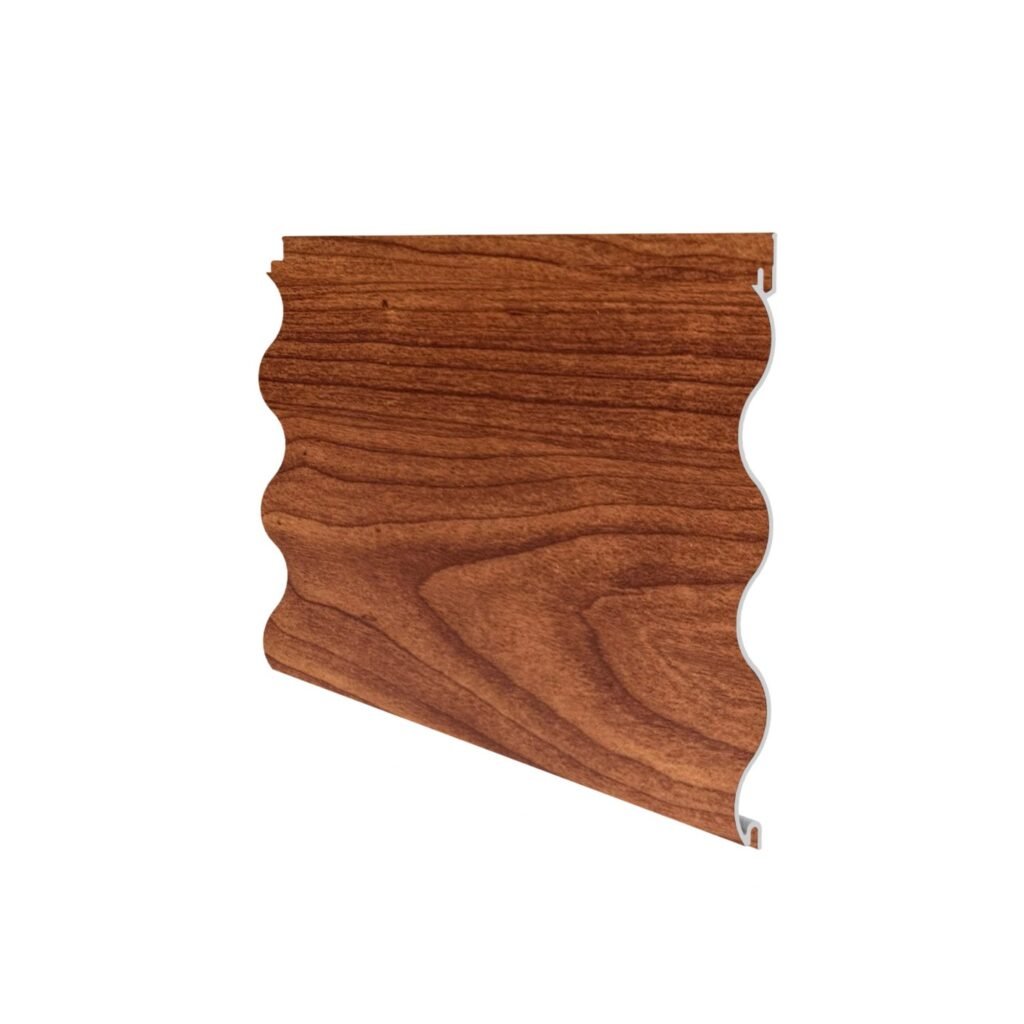
Corrugated aluminum siding adds depth and texture to a building through repeating ribs and changing shadows. It can make an entrance more prominent, emphasize a gable or give a simple exterior a stronger architectural identity.
The result depends on more than the profile. Colour, orientation, window placement and surrounding materials determine whether the building feels contemporary, warm or distinctly industrial.
For homeowners and contractors, choosing corrugated siding means considering both its appearance and the wall system behind it.
What Is Corrugated Aluminum Siding?
Corrugated aluminum siding is exterior cladding with repeating raised and recessed sections. Often called ribbed aluminum siding, it creates more pronounced texture than flat or lightly grooved profiles.
“Corrugated” describes the geometry, rather than a single manufacturing method.
Roll-Formed Sheets vs Extruded Aluminum
Conventional corrugated panels are commonly made by forming thin metal sheets through rollers. Extruded profiles are made by pushing aluminum through a die that creates the cross-section, including its ribs and connection details.
VEDREX uses extruded aluminum for its Corrugated profile:
| Specification | VEDREX Corrugated |
|---|---|
| Profile size | 6 inches |
| Material | 6063-T6 aluminum alloy |
| Weight | 0.573 lb per linear foot |
| Maximum length | 19 feet |
The 6-inch designation identifies the profile size, not the distance between individual ribs. You can compare it with other profiles in the VEDREX aluminum siding system.
What About Oil Canning?
Oil canning is visible waviness in the flatter areas of metal panels. It can occur in both steel and aluminum, and may become particularly noticeable when sunlight strikes the surface at an angle.
Panel geometry, manufacturing stresses, support alignment and installation all influence its appearance. The Metal Construction Association’s guide to oil canning explains why careful material selection and installation can reduce the tendency without guaranteeing its complete prevention.
A ribbed profile breaks up broad flat surfaces, while extrusion allows the cross-section to be designed for rigidity. These are useful design characteristics, but they should not be treated as proof that a particular product can never show distortion.
For a consistent appearance, evaluate a physical sample or mock-up and follow the specified fastening, support and expansion details.
Corrugated Siding Design Ideas
Corrugated siding has historical associations with barns, workshops and warehouses. On a house, large uninterrupted metal surfaces can reinforce that industrial character.
Windows, recessed entrances, masonry and changes in profile help control the effect. The following combinations show how ribbed siding can contribute to a residential design without dominating every elevation.
A Woodgrain Entrance Against Pale Brick
Use vertical woodgrain corrugated aluminum around a recessed front door, with pale brick across the surrounding walls.
The ribs give the entrance depth, while the wood tone softens the contrast between metal and masonry. A restrained canopy and simple lighting keep attention on the doorway.
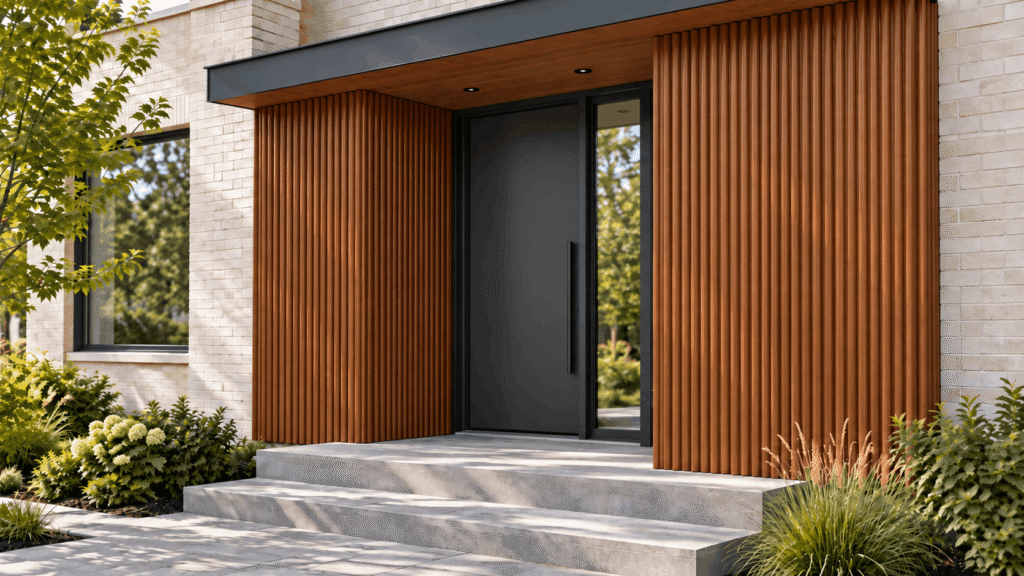
This is a useful application for wood grain aluminum siding when you want warmth concentrated in one part of the façade.
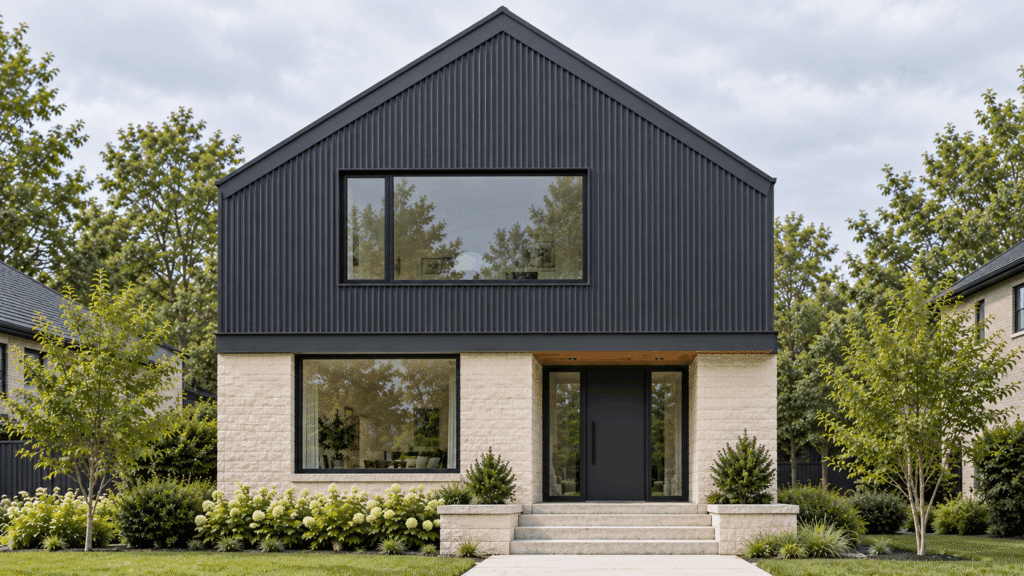
A Charcoal Gable Above a Stone Base
Place vertical charcoal corrugated siding on a gabled upper section, with light stone below and a large window within the gable.
The vertical lines emphasize height, while the stone gives the lower elevation a quieter appearance. Keeping trims close to the siding colour allows the roof shape and ribbed texture to remain the main features.
Corrugated and V-Groove Siding in the Same Finish
Use vertical corrugated siding on a projecting upper storey and horizontal V-Groove siding below, both in the same colour.
The contrast comes from geometry and direction rather than a growing list of materials. This approach works particularly well on contemporary homes with clearly defined rectangular volumes.
A Garage Connected to the Main House
Use corrugated aluminum on the garage walls, then repeat a colour or woodgrain finish from the main house at the soffit or entrance.
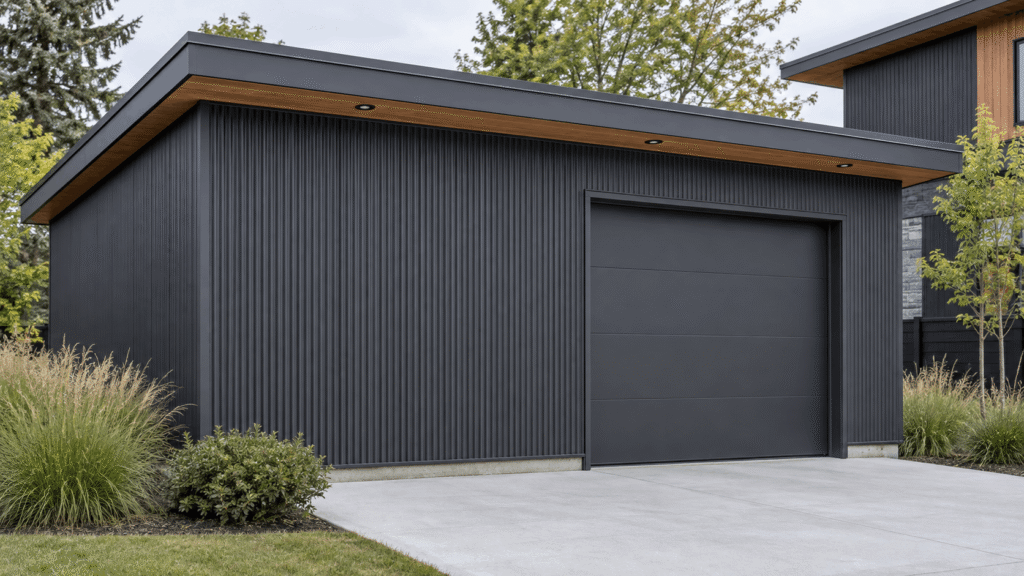
Keep the garage door visually simple so it does not compete with the wall texture. When planning aluminum siding for garage walls and soffits, consider the roof edge, corners and adjoining elevations together.
Colours, Finishes and Matching Accessories
VEDREX Corrugated siding can be supplied in the same colour and finish range as its V-Groove siding, with coordinating finishes for exposed trims and accessories. This allows you to change the profile while maintaining a consistent exterior palette.
Explore the available woodgrain, solid and metallic finishes, including custom colour options. Confirm the selected finish, accessory specification and order availability together; concealed components may be supplied in mill finish.
Woodgrain can soften the industrial character of the ribs. Dark colours give the wall more visual weight, while lighter finishes often create a quieter appearance.
View samples outdoors and from different distances. The same finish can look different across corrugated and V-Groove profiles because their surfaces catch light differently.
Corrosion Resistance: Aluminum vs Galvanized Steel
Both materials can perform well outdoors, but they resist corrosion in different ways.
How VEDREX Aluminum Resists Corrosion
Aluminum naturally forms a protective oxide layer. Unlike galvanized steel, it has no carbon-steel core that can develop red rust when exposed. The Aluminum Association explains this natural protection in its guidance on aluminum in green buildings.
VEDREX siding is corrosion-resistant and uses powder-coating and sublimation processes for its finishes. It follows industry standards including AAMA 2604/2605 and DIN EN ISO 9227:1990.
For demanding exposure conditions, read our documentation for the selected finish through VEDREX’s technical resources.
Corrosion resistance still depends on suitable detailing. Aluminum can suffer localized corrosion under certain conditions, so compatible fasteners, drainage and appropriate separation from incompatible materials remain important.
Limitations of Galvanized Corrugated Siding
Galvanized steel relies on zinc to protect the underlying steel. Zinc provides a barrier and sacrificial protection, so a small scratch does not necessarily produce immediate rust.
However, significant damage or eventual depletion of the protective zinc can leave steel vulnerable. The American Galvanizers Association explains the mechanism in its guidance on zinc coatings for corrosion protection.
Practical considerations include protecting field cuts, inspecting damaged areas and choosing a coating suitable for the environment. Thin sheet products may also be vulnerable to dents or visible distortion, depending on their gauge, geometry and support.
These limitations do not make galvanized siding unsuitable. They make product specifications and installation details more useful than broad claims that one metal is always better.
Rainscreen, Insulation and Summer Heat
A metal façade is the outer surface of a much larger assembly. Its temperature and appearance do not tell you how well the building controls moisture or energy use.
What the Rainscreen Needs to Do
A rainscreen provides separation behind the cladding so water can drain and, in a ventilated design, air can circulate to support drying. VEDREX describes its siding system as supporting drainage and ventilation behind the surface.
The complete design should address:
- A clear drainage route: water must be able to exit at the appropriate flashings.
- A suitable cavity: depth and openings must follow the specified assembly.
- Continuous weather protection: coordinate the water-resistive layer around windows, doors and penetrations.
- Correct supports: furring and attachments must support the siding without obstructing drainage.
- Ventilation and protection: detail openings, insect screens and required cavity barriers together.
Visible ribs on the outside of siding do not automatically create a functioning rainscreen behind it. Review the aluminum siding installation guide alongside the project’s wall details.
Insulation Is a Separate Requirement
Corrugated aluminum is cladding, not insulation. A ventilated cavity also does not replace the wall’s required thermal resistance.
The assembly needs appropriately specified insulation, a continuous air barrier and a moisture-control strategy. Exterior continuous insulation can help reduce thermal bridging, but attachments and supporting components must be considered in the design.
Natural Resources Canada’s guide to insulating exterior walls discusses coordinating insulation with air barriers, drainage and siding.
There is no single insulation thickness appropriate for every corrugated siding project. Required performance depends on the building, location, existing construction and applicable energy requirements.
Does Thin Galvanized Steel Get Hotter Than Extruded Aluminum?
Thin galvanized steel, thin aluminum sheet and extruded aluminum can all become hot in direct sunlight. Thin sheets generally respond quickly to changing conditions because they have relatively little thermal mass per unit area. A heavier extrusion changes that response, but it does not automatically remain cooler or prevent heat from entering the wall.
Surface temperature depends strongly on solar absorption, heat emission, wind and exposure. Aluminum itself conducts heat readily; the greater thickness of VEDREX profiles should not be presented as an insulating benefit.
To limit the effect on cooling demand:
- Consider finishes with documented solar-reflectance performance.
- Provide the drainage and ventilation cavity specified for the system.
- Use adequate insulation and continuous air sealing.
- Address thermal bridges through supporting components.
- Consider shading on heavily exposed elevations.
Berkeley Lab’s research on solar-reflective cool walls explains how surface reflectance and thermal emittance influence solar heat gain. Actual annual energy savings depend on climate and the whole building; Ontario projects should consider winter heating as well as summer cooling.
Choosing Corrugated Aluminum for Your Project
Start with the role the siding should play: a textured entrance, a stronger gable, a contrasting upper storey or a complete ribbed façade.
Then compare samples, finish options, joints and installation details. The strongest result comes from coordinating appearance with corrosion protection, drainage and thermal performance.
To discuss profiles and matching finishes for your project, contact VEDREX.
Frequently Asked Questions
Is corrugated aluminum siding the same as ribbed siding?
The terms overlap. Ribbed siding is a broad description, while corrugated generally refers to a repeating raised-and-recessed profile.
Can corrugated siding be installed vertically or horizontally?
Both orientations are possible in suitable systems. Confirm the manufacturer’s details for the chosen application because supports, joints and drainage may change with orientation.
Can VEDREX Corrugated match V-Groove siding?
Yes. Corrugated can use the same colour and finish range, allowing the profiles and exposed accessories to coordinate. Confirm the exact components and finish selection when ordering.