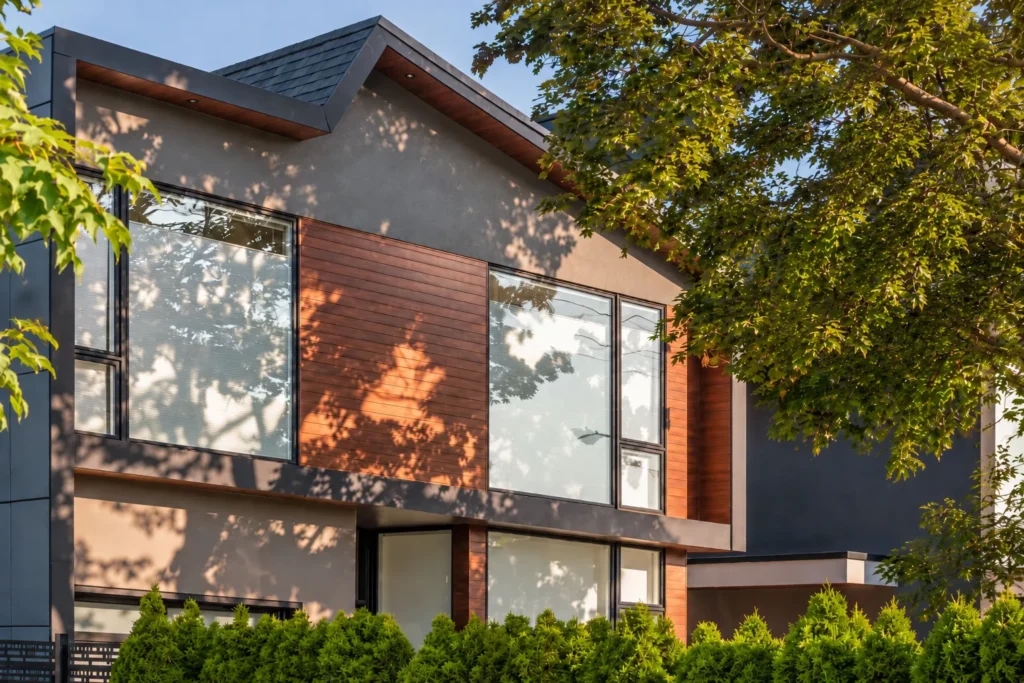
Aluminum siding is widely used for exterior walls because it does not rust like steel, does not absorb moisture like wood, and can remain durable through decades of outdoor exposure.
But does aluminum siding oxidize?
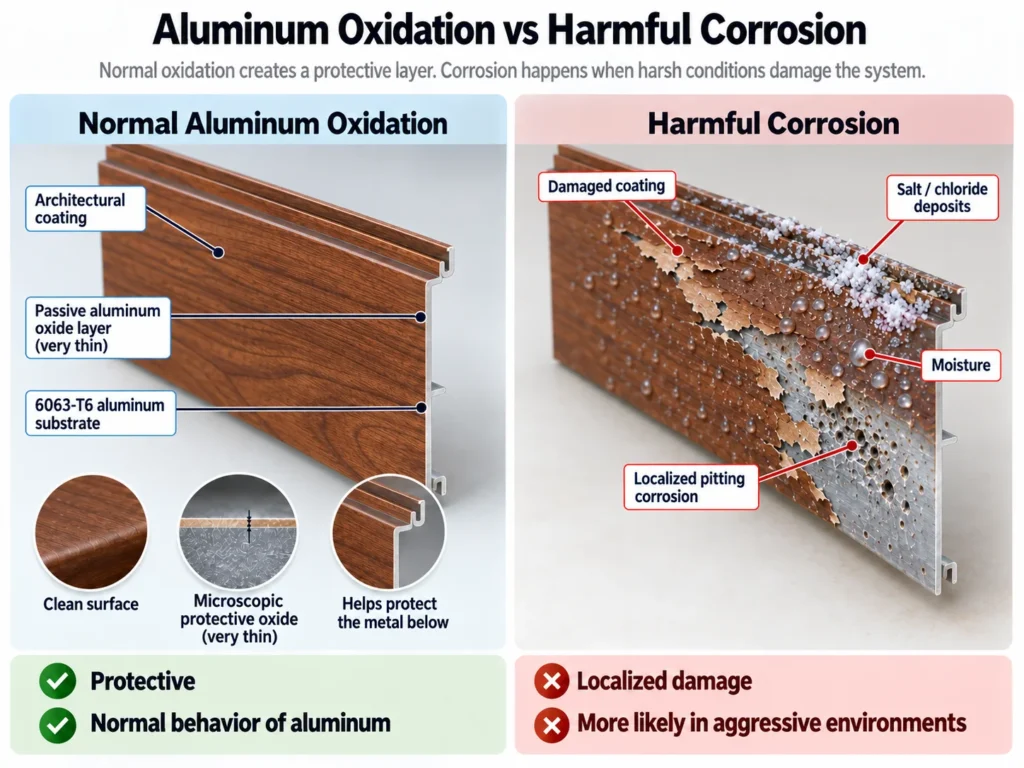
Yes. Aluminum naturally oxidizes whenever its surface is exposed to oxygen. The important distinction is that normal aluminum oxidation is usually protective rather than destructive.
When aluminum reacts with oxygen, it quickly develops a very thin layer of aluminum oxide. This layer adheres tightly to the metal and helps protect the aluminum underneath. European Aluminium identifies this naturally forming oxide layer as one of the reasons aluminum performs well as a long-lasting construction material.
You can read more about aluminum’s natural corrosion resistance.
Problems can still occur, particularly when aluminum is exposed to salt, aggressive chemicals, trapped moisture, incompatible metals, damaged coatings, or poor installation details.
This guide explains why aluminum siding oxidizes, when oxidation becomes a concern, how harmful corrosion can be delayed, which types of siding are less prone to corrosion, which standards are relevant, and how VEDREX aluminum siding performs in exterior environments.
What Is Aluminum Siding Oxidation?
Oxidation is a chemical reaction between a material and oxygen.
When freshly exposed aluminum comes into contact with air, oxygen reacts with the aluminum surface and creates aluminum oxide.
This happens very quickly.
Unlike rust on carbon steel, however, aluminum oxide normally forms a thin, tightly bonded surface layer that helps reduce further reaction with the underlying material.
This process is commonly described as passivation.
So the question is not really:
“How do I stop aluminum from oxidizing?”
Natural oxidation is essentially unavoidable and is part of aluminum’s normal protective behaviour.
A more useful question is:
“How do I prevent normal oxidation from developing into visible or localized corrosion?”
That distinction is important when choosing aluminum siding for a building.
Aluminum Oxidation Is Not the Same as Rust
The terms oxidation, corrosion, and rust are often used interchangeably, but they do not describe exactly the same process.
| Term | What It Means |
|---|---|
| Oxidation | A chemical reaction involving oxygen |
| Aluminum oxide | The thin protective layer that naturally forms on aluminum |
| Corrosion | Deterioration of a metal through chemical or electrochemical reactions with its environment |
| Rust | Iron oxide created when iron or steel corrodes |
| Chalking | Powdery degradation of a coating, which may sometimes be mistaken for oxidation |
Aluminum siding therefore does not develop traditional red iron rust because aluminum does not contain the iron required to create it.
That does not mean aluminum is completely immune to corrosion.
Under certain conditions, aluminum can experience:
- pitting corrosion
- galvanic corrosion
- crevice corrosion
- surface staining
- coating deterioration
The advantage is that under normal atmospheric conditions, aluminum is naturally much more resistant to destructive corrosion than many ferrous metals.
Why Does Aluminum Siding Oxidize?
Oxidation starts naturally whenever bare aluminum is exposed to air.
Under ordinary exterior conditions, this initial oxidation is generally beneficial because it creates a protective surface.
Problems become more likely when the protective oxide layer or exterior coating is repeatedly disturbed or attacked by the surrounding environment.
Several factors influence aluminum siding corrosion.
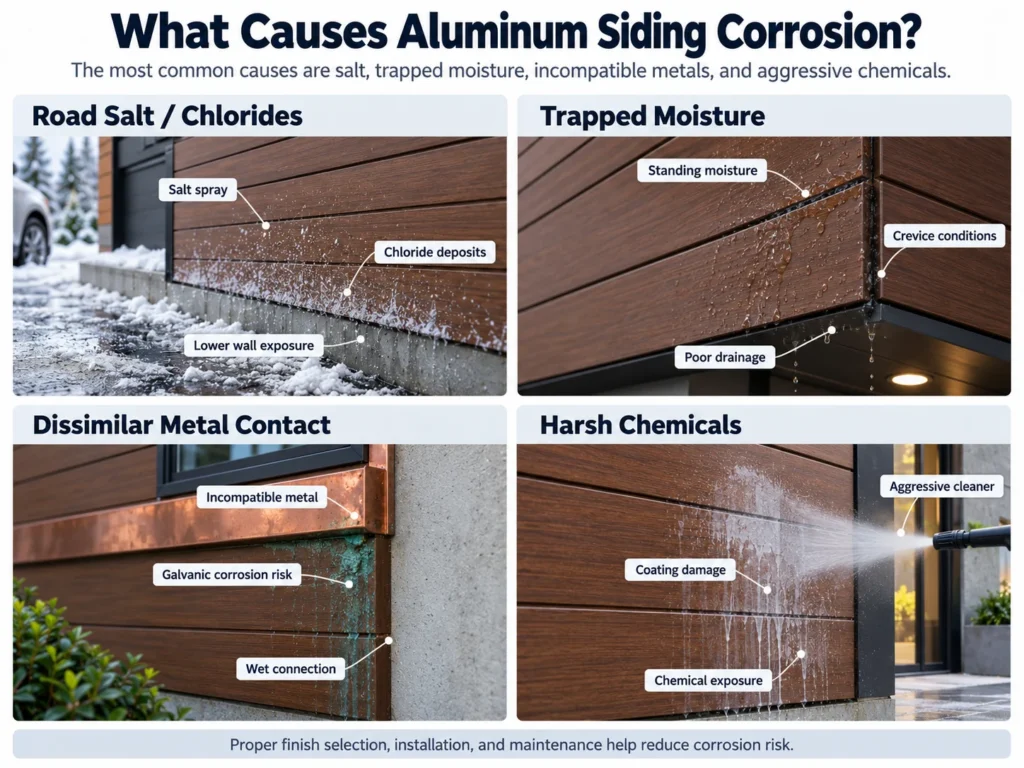
1. Salt and Chlorides
Salt exposure is one of the most important environmental concerns for exterior aluminum.
Chlorides can come from:
- coastal air
- sea spray
- winter road salt
- salted driveways
- parking lots
- contaminated water
- some industrial environments
Chloride ions can interfere with aluminum’s passive oxide layer and encourage localized pitting corrosion.
This issue is not limited to coastal buildings.
For homes and commercial properties in Ontario, winter road salt can also be relevant. Lower sections of siding near roads, parking areas, sidewalks, and driveways may be repeatedly exposed to salty spray during winter.
Regular cleaning can help remove accumulated chlorides before they remain on the surface for long periods.
2. Constant Moisture and Poor Drying
Rainfall by itself is generally not a serious problem for properly installed aluminum siding.
The greater concern is moisture that remains trapped against the material and cannot dry efficiently.
Potential problem areas include:
- poorly drained horizontal surfaces
- deep joints and crevices
- badly detailed transitions
- areas where dirt retains moisture
- locations with limited ventilation
- siding installed without appropriate drainage behind it
This is one reason drainage and ventilation are important parts of exterior wall design.
A properly detailed rainscreen system gives water a path to drain and allows moisture behind the exterior cladding to dry.
VEDREX siding is designed as an architectural cladding system rather than simply a decorative sheet attached directly to a wall. You can review its available profiles and system characteristics on the VEDREX aluminum siding page.
3. Contact With Dissimilar Metals
Another potential source of aluminum corrosion is galvanic corrosion.
Galvanic corrosion can occur when two dissimilar metals are electrically connected while moisture acts as an electrolyte.
The risk depends on:
- the metals involved
- the size of the contact area
- moisture exposure
- salt concentration
- installation details
Direct contact between aluminum and certain metals such as copper or inappropriate steel components may accelerate aluminum corrosion under the wrong conditions.
Good exterior detailing therefore includes:
- suitable fasteners
- compatible trims and accessories
- proper flashing
- isolation between incompatible metals where required
- preventing contaminated runoff from reaching aluminum surfaces
This is one reason installers should follow the manufacturer’s recommended fastening and accessory system instead of substituting unrelated materials.
For a broader overview of installation considerations, see the VEDREX guide to aluminum siding installation.
4. Strong Acids and Alkaline Chemicals
Aluminum’s passive oxide layer performs best within a moderate chemical environment.
Strong acids and strong alkaline substances can attack this protective layer.
Potential sources around buildings include:
- harsh cleaning chemicals
- masonry cleaning products
- cement and mortar contamination
- industrial fumes
- chemical-processing activities
- unsuitable detergents
This is why cleaning aluminum siding with aggressive chemicals is generally a poor idea unless specifically approved by the manufacturer.
A cleaning product that removes a stain quickly may also damage the coating protecting the aluminum underneath.
5. Damage to the Exterior Finish
Finished aluminum siding normally has another protective barrier between the environment and the aluminum substrate.
This may include:
- powder coating
- architectural paint systems
- anodizing
- specialized decorative finishes
Scratching, abrasion, improper cutting, transportation damage, or aggressive cleaning can compromise this protective layer.
The exposed aluminum will still develop its natural oxide film, but a damaged area may weather differently from the surrounding finished surface.
The effect becomes more significant in aggressive environments containing salt or chemical contamination.
6. Industrial Pollution
Industrial environments can expose building materials to conditions that are far more aggressive than an ordinary residential neighbourhood.
Possible contaminants include:
- sulfur compounds
- acidic particles
- alkaline dust
- chemical vapours
- manufacturing emissions
- metal particles
For buildings close to industrial facilities, material and coating selection should therefore be evaluated according to the specific environment.
The same siding specification used on a suburban house may not automatically be appropriate beside a chemical-processing facility.
Which Environments Cause More Aluminum Corrosion?
Environmental exposure has a major influence on corrosion.
ISO 9223 provides a framework for classifying atmospheric corrosivity and considers environmental factors including humidity, sulfur dioxide pollution, and airborne salinity.
You can review the ISO 9223 atmospheric corrosivity classification.
For siding projects, the following general comparison is useful:
| Environment | Relative Corrosion Concern | Main Reason |
|---|---|---|
| Typical suburban residential area | Low | Limited salt and chemical exposure |
| Urban Ontario environment | Low to moderate | Pollution, moisture, and winter contaminants |
| Building close to a heavily salted road | Moderate | Repeated chloride deposits |
| High-humidity area with poor drying | Moderate | Extended surface wetness |
| Industrial environment | Moderate to high | Depends on airborne contaminants |
| Coastal environment | High | Chloride-rich salt exposure |
| Chemical-processing environment | Potentially high | Acids, alkalis, or aggressive fumes |
| Areas exposed to standing salty water | High | Continuous moisture combined with chloride exposure |
These categories should be treated as general guidance rather than guaranteed product-performance ratings.
For aggressive environments, architects and contractors should evaluate:
- coating specification
- aluminum alloy
- fasteners
- accessories
- drainage
- cleaning requirements
- local exposure conditions
as a complete system.
Is White Powder on Aluminum Siding Always Oxidation?
No.
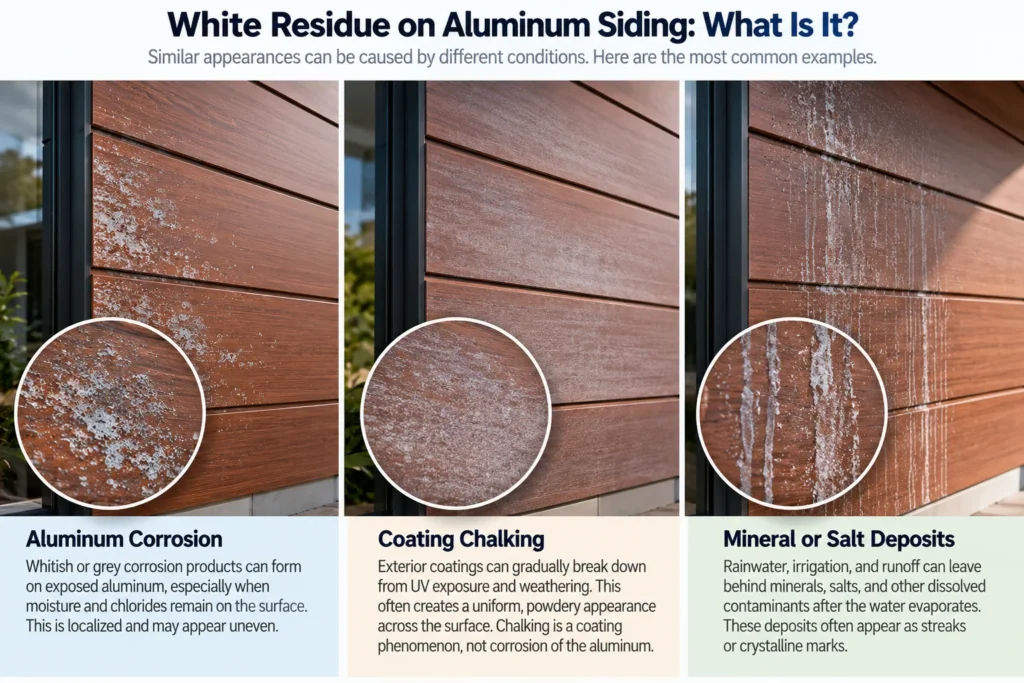
This is an important distinction because homeowners sometimes see a pale, grey, or powdery surface and immediately assume that the aluminum itself is corroding.
Several different conditions can produce a similar appearance.
Aluminum Corrosion Products
Exposed aluminum can develop whitish or grey corrosion products under certain conditions, especially when moisture and chlorides remain on the surface.
Coating Chalking
Exterior coatings can gradually degrade from ultraviolet exposure and weathering.
This may produce a powdery material on the surface known as chalking.
Chalking is a coating phenomenon and is not necessarily corrosion of the aluminum substrate.
Mineral Deposits
Rainwater, irrigation water, and runoff can leave behind:
- calcium
- salts
- minerals
- other dissolved contaminants
after the water evaporates.
Dirt and Pollution
Fine particles can also accumulate on textured siding and create a dull or powdery appearance.
Before treating aluminum siding for “oxidation,” it is therefore important to identify what is actually on the surface.
Using strong chemicals or abrasive cleaning methods without identifying the problem can potentially make the condition worse.
Which Types of Siding Are Less Prone to Oxidation?
The answer depends partly on what is meant by oxidation.
Non-metallic materials such as vinyl and fibre cement do not experience metallic oxidation at all. However, they have their own deterioration mechanisms.
Among metal siding systems, the substrate and finish both influence corrosion performance.
| Siding Type | Typical Oxidation / Corrosion Behaviour |
|---|---|
| Coated architectural aluminum | Strong atmospheric corrosion resistance plus an additional protective coating |
| Anodized aluminum | Uses an intentionally thickened oxide layer for surface protection |
| Bare architectural aluminum | Naturally passivates but may change appearance and can pit in aggressive conditions |
| Painted steel | Performs well while the coating remains intact, but exposed steel can rust |
| Galvanized steel | Zinc protects the steel substrate but the protective zinc layer can eventually deteriorate |
| Copper siding | Intentionally oxidizes and develops a patina |
| Zinc siding | Develops a protective surface patina |
For projects where the goal is to combine metal construction with strong atmospheric corrosion resistance, properly coated architectural aluminum is one of the most practical choices.
For a broader material comparison, see our guide to aluminum siding vs vinyl siding for Ontario climates.
Does the Aluminum Alloy Matter?
Yes.
Aluminum is not a single material. It is a family of alloys designed for different combinations of properties.
Different aluminum alloys may be optimized for:
- strength
- extrusion
- forming
- welding
- machining
- corrosion resistance
- surface appearance
- architectural finishing
For architectural extrusion, alloys from the 6000 series are particularly common.
One of the most widely used architectural extrusion alloys is 6063 aluminum.
6063 combines:
- good extrusion characteristics
- smooth surface quality
- good corrosion resistance
- compatibility with architectural finishing systems
- suitable mechanical properties for many exterior profiles
Hydro identifies 6063 as a widely used alloy for architectural extrusions and notes its corrosion resistance.
More information is available in Hydro’s overview of 6063 aluminum extrusion alloy.
However, the alloy should not be evaluated by itself.
Exterior corrosion performance should be considered as:
alloy + surface preparation + coating + installation + drainage + maintenance + environment
A good alloy with poor installation can still develop problems.
Likewise, a well-designed coating system can significantly improve the performance of the underlying aluminum.
What Aluminum Finish Provides Better Oxidation Protection?
Exterior aluminum can use several different surface treatments.
Bare Aluminum
Bare aluminum relies largely on the naturally forming aluminum oxide layer for corrosion protection.
This can perform well in many environments, but its appearance may change over time.
Aggressive chloride exposure can also cause localized pitting.
Anodized Aluminum
Anodizing is an electrochemical process that intentionally thickens aluminum’s natural oxide layer.
Anodized aluminum can provide strong resistance to:
- weathering
- abrasion
- corrosion
when the anodized layer is properly specified for the intended environment.
Powder-Coated Architectural Aluminum
Powder coating adds a physical barrier between the external environment and the aluminum substrate.
A properly prepared and applied architectural coating can improve:
- colour stability
- appearance
- weather resistance
- corrosion resistance
- resistance to direct environmental exposure
However, not every powder coating has the same performance.
This is where coating standards become important.
What Standards Apply to Aluminum Siding Coatings and Corrosion?
There is no single standard that certifies siding as completely “oxidation-proof.”
Instead, architects, manufacturers, coating suppliers, and testing laboratories use several standards to evaluate exterior coating and corrosion performance.
AAMA 2603, AAMA 2604, and AAMA 2605
The architectural aluminum industry commonly references three important coating specifications:
- AAMA 2603
- AAMA 2604
- AAMA 2605
These specifications represent progressively more demanding performance categories for organic coatings on architectural aluminum.
In general:
| Standard | General Performance Category |
|---|---|
| AAMA 2603 | Basic architectural coating performance |
| AAMA 2604 | High-performance architectural coating |
| AAMA 2605 | Superior-performance architectural coating |
Testing may evaluate characteristics including:
- adhesion
- hardness
- colour uniformity
- chemical resistance
- humidity resistance
- corrosion resistance
- chalking
- gloss retention
- colour retention
- weathering
AAMA 2605 generally represents a more demanding exterior-performance category than AAMA 2604, while AAMA 2604 is more demanding than AAMA 2603.
For exterior siding, knowing the actual coating specification is therefore much more useful than simply being told that a product is “painted aluminum.”
ISO 9227 Salt Spray Testing
Another important reference is ISO 9227, which establishes procedures for artificial salt spray testing.
These tests expose metals or coated metal samples to controlled corrosive conditions to evaluate how the material or coating behaves.
You can review the ISO 9227 corrosion testing standard.
However, accelerated salt spray testing should not be interpreted as a direct prediction of real-world service life.
For example:
3,000 hours of salt spray testing does not automatically mean a product will last a specific number of years outdoors.
Actual buildings experience changing combinations of:
- rainfall
- drying
- sunlight
- ultraviolet exposure
- freeze-thaw cycles
- pollutants
- road salt
- temperature changes
- cleaning
- mechanical damage
Laboratory corrosion testing is therefore useful for comparing systems and identifying weaknesses, but it should not be converted directly into a simple lifespan claim.
ASTM B117
ASTM B117 is another widely used practice for salt spray testing of metals and coated metal products.
It creates a controlled corrosive environment that can help evaluate the relative performance of coatings and substrates.
Like ISO 9227, ASTM B117 is best understood as an accelerated laboratory test rather than an exact simulation of decades of real-world exposure.
How Can Aluminum Siding Corrosion Be Prevented or Postponed?
You generally do not need to prevent aluminum’s natural oxide formation.
Instead, the objective is to prevent the conditions that can cause localized corrosion or premature coating deterioration.
Several measures can improve long-term performance.
1. Choose an Appropriate Aluminum Alloy
Established architectural extrusion alloys such as 6063 are commonly selected because they provide a useful combination of:
- corrosion resistance
- structural properties
- finish quality
- extrusion performance
The alloy should still be paired with an appropriate exterior finish.
2. Use an Exterior-Grade Architectural Coating
A durable architectural coating creates another protective layer between the aluminum and the environment.
This reduces direct exposure to:
- salt
- moisture
- pollutants
- airborne contaminants
For demanding projects, the coating specification should be selected according to the actual exposure environment rather than colour alone.
3. Avoid Damaging the Finish
During transportation, storage, cutting, and installation:
- protect finished surfaces
- avoid dragging profiles across abrasive materials
- use suitable cutting tools
- avoid scratching visible areas
- follow manufacturer guidance for minor repairs
- keep metal filings away from finished surfaces
Metal fragments from cutting or drilling can sometimes create staining if they remain on finished aluminum.
4. Use Compatible Fasteners and Accessories
The siding system should use compatible:
- screws
- clips
- trims
- flashings
- brackets
- accessories
This reduces the risk of galvanic interaction between incompatible metals.
Where dissimilar metals must be used, appropriate isolation may be necessary.
5. Provide Proper Drainage
Exterior walls should be designed so water does not remain trapped.
Good detailing should allow:
- drainage
- drying
- ventilation
- controlled runoff
This is particularly important at:
- window openings
- wall transitions
- lower wall sections
- roof intersections
- horizontal ledges
- penetrations
6. Remove Salt Deposits
Salt should not be allowed to accumulate indefinitely.
Buildings exposed to:
- winter road spray
- parking-lot salt
- coastal salt
- industrial contaminants
may benefit from periodic freshwater cleaning.
Cleaning frequency should reflect actual exposure.
7. Avoid Harsh Cleaning Products
Strong acids, highly alkaline cleaners, abrasives, and aggressive solvents can damage exterior coatings.
Manufacturer-approved cleaning procedures should always take priority.
8. Inspect High-Risk Areas
Particular attention should be paid to:
- siding close to salted roads
- walls beside driveways
- areas underneath downspouts
- horizontal surfaces
- panel edges
- deep scratches
- areas where different metals meet
- sheltered locations not naturally rinsed by rain
Small problems are generally easier to correct before corrosion becomes established.
How Does VEDREX Aluminum Siding Perform Against Oxidation?
VEDREX manufactures its architectural siding profiles using 6063-T6 extruded aluminum.
The aluminum substrate is then protected by factory-applied architectural finishes.
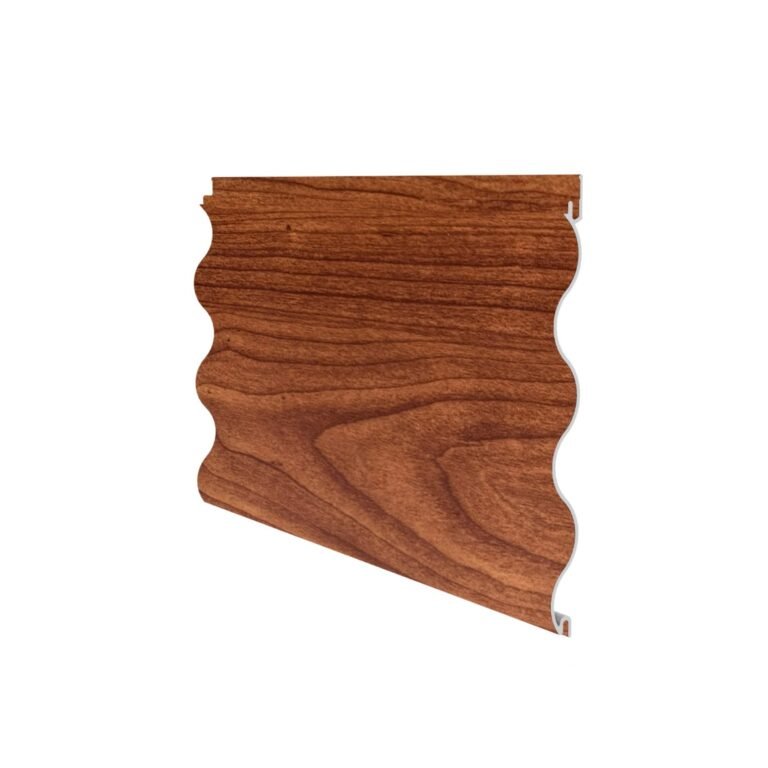
Solid-colour products use powder-coated finishes, while woodgrain products use a decorative sublimation process over the coated aluminum.
You can review available options on the VEDREX aluminum finishes page.
The aluminum itself already provides strong resistance to normal atmospheric corrosion.
The exterior finish adds another barrier between the substrate and the surrounding environment.
VEDREX’s warranty states that when the product is properly installed and maintained, it will not rust or corrode under normal atmospheric exposure, subject to the warranty’s complete terms and exclusions.
The current warranty provides:
- 50 years for the aluminum substrate
- 15 years for the factory-applied finish
The finish warranty also addresses performance characteristics including:
- adhesion
- cracking
- checking
- chalking
- colour retention
- gloss retention
The VEDREX warranty specifically references AAMA 2604-02 in relation to coating adhesion requirements.
This supports an important distinction:
VEDREX is not relying only on the fact that aluminum naturally resists corrosion.
The system combines:
architectural aluminum + factory finish + defined installation requirements + maintenance requirements
to support long-term exterior performance.
Maintenance Still Matters With Corrosion-Resistant Aluminum
Low maintenance does not mean no maintenance.
VEDREX’s current maintenance requirements specify periodic cleaning with fresh water and mild non-abrasive soap within an appropriate pH range.
Harsh chemicals, abrasive cleaning methods, and unsuitable pressure washing can damage architectural finishes.
Routine cleaning helps remove:
- winter road salt
- atmospheric pollution
- dust
- dirt
- industrial residue
- mineral deposits
that might otherwise remain on the surface and hold moisture.
Buildings near roads, parking areas, industrial zones, or other contamination sources deserve particular attention.
Additional technical information is available through the VEDREX resources library.
Aluminum vs Galvanized Steel: Which Handles Oxidation Better?
Aluminum and galvanized steel both resist exterior corrosion, but they protect themselves differently.
Galvanized Steel
Galvanized steel uses a zinc coating over a carbon-steel substrate.
The zinc layer helps protect the steel through both barrier protection and sacrificial corrosion.
If the zinc and any additional coatings eventually become sufficiently damaged or depleted, exposed steel can develop red rust.
Aluminum
Aluminum does not rely on a carbon-steel core.
When exposed, the aluminum surface naturally develops a passive aluminum oxide film.
That means exposed aluminum does not develop traditional red iron rust.
However, aluminum can still experience:
- pitting
- galvanic corrosion
- crevice corrosion
- chemical attack
under sufficiently aggressive conditions.
For exterior architectural applications, this natural passivation is one of aluminum’s most important material advantages.
Frequently Asked Questions About Aluminum Siding Oxidation
Why does aluminum turn white?
Visible white or grey deposits may be caused by aluminum corrosion products, but they can also result from:
coating chalking
road salt
mineral deposits
pollution
cleaning residue
The surface should be properly identified before aggressive cleaning is attempted.
Is aluminum oxidation bad?
Normal microscopic oxidation is generally not harmful.
It is part of aluminum’s natural protective mechanism.
Visible pitting, extensive surface deposits, or coating failure may indicate a more serious environmental or maintenance issue.
Does powder coating prevent aluminum oxidation?
Powder coating greatly reduces direct environmental contact with the aluminum substrate.
However, no exterior coating should be considered permanently indestructible.
What happens when powder-coated aluminum gets scratched?
Exposed aluminum will naturally form an oxide layer.
The long-term effect depends on:
scratch depth
environmental exposure
salt contamination
moisture
location
Manufacturer repair procedures should be followed when significant coating damage occurs.
Can road salt damage aluminum siding?
Yes, particularly if chloride deposits remain on the surface for long periods.
This is most relevant for lower portions of walls located close to:
salted roads
driveways
parking lots
sidewalks
Periodic freshwater cleaning can help reduce salt accumulation.
Is aluminum siding suitable for Ontario?
Aluminum is well suited to many Ontario exterior applications because it:
does not absorb water
does not develop iron rust
tolerates seasonal temperature changes
has strong atmospheric corrosion resistance
Winter road salt, trapped moisture, and appropriate installation still need to be considered.
What siding is least prone to corrosion?
Among metal siding materials, properly coated architectural aluminum offers very strong resistance to ordinary atmospheric corrosion.
Non-metallic materials such as vinyl and fibre cement do not experience metallic corrosion but have different durability considerations.
The best siding choice should consider the complete building environment rather than corrosion alone.
Final Thoughts
Aluminum siding oxidation is not automatically a sign that the siding is deteriorating.
Aluminum naturally reacts with oxygen and creates a thin protective oxide film.
That passive layer is one of the primary reasons aluminum performs so well in exterior architectural applications.
Problems become more likely when the protective system is exposed to conditions such as:
- concentrated salt
- persistent moisture
- aggressive chemicals
- incompatible metals
- coating damage
- unsuitable installation details
The best way to evaluate corrosion resistance is therefore not simply to ask whether a siding product is made from aluminum.
Instead, consider the complete system:
alloy + architectural finish + installation + drainage + compatible accessories + maintenance + exposure environment
VEDREX combines 6063-T6 extruded architectural aluminum, factory-applied powder-coated or sublimated finishes, compatible siding components, and defined maintenance requirements.
For normal atmospheric applications, this provides a strong foundation for long-term corrosion resistance.
For coastal, industrial, or unusually aggressive environments, the project should be evaluated separately and the exact coating specification should be confirmed before installation.