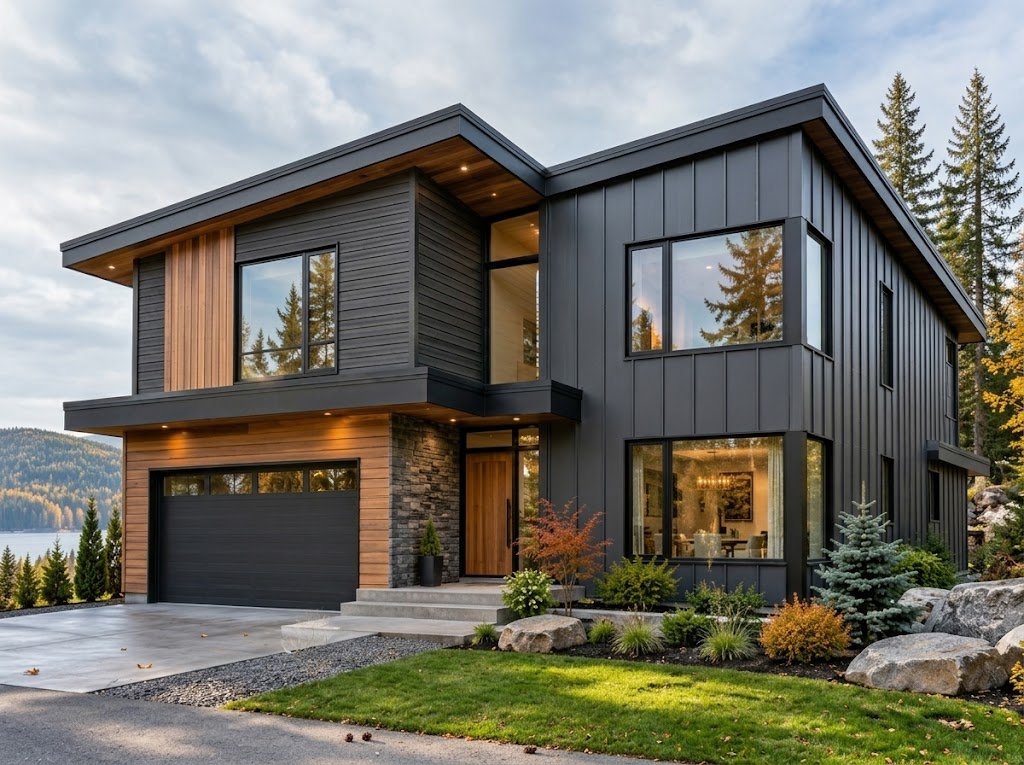
When comparing aluminum siding vs steel siding, it is easy to treat them as two versions of the same thing.
Both are metal. Both can create durable exterior façades. Both are available in modern colours and profiles. Both can work well on Canadian residential and commercial buildings.
But their behaviour is not identical.
Steel siding is typically manufactured from coated sheet steel that is roll-formed into panels. Modern architectural aluminum can also be roll-formed, but systems such as VEDREX aluminum siding use 6063-T6 extruded aluminum profiles rather than the thin sheet aluminum many homeowners associate with houses built or renovated several decades ago.
That distinction matters.
If your idea of aluminum siding is based on older residential products that dented easily, faded, chalked or developed an uneven appearance, you are comparing steel against a very different generation of aluminum siding.
This guide looks at steel vs aluminum siding for Canadian buildings based on:
- material construction
- corrosion and rust resistance
- Canadian winter conditions
- impact resistance
- panel rigidity
- installation
- colour and finish options
- maintenance
- lifespan
- building standards
- sustainability
- initial and long-term cost
The objective is not to argue that steel is a bad siding material. Properly manufactured and coated steel can provide excellent exterior performance.
The more useful question is: which metal siding system makes more sense for your particular building?
Aluminum Siding vs Steel Siding: Quick Comparison
| Consideration | Modern Extruded Aluminum Siding | Steel Siding |
|---|---|---|
| Base material | Non-ferrous aluminum alloy | Carbon steel with protective metallic/coating system |
| Red rust | Does not develop red iron rust | Steel substrate can rust if its protective system is sufficiently compromised |
| Weight | Lower material density | Significantly higher material density |
| Rigidity | Highly dependent on profile; extrusions can be very rigid | Generally strong; depends heavily on gauge and profile |
| Impact resistance | Strong with substantial extruded profiles | Often excellent, especially with heavier-gauge products |
| Oil canning | Depends on profile, thickness and installation; narrow rigid extrusions reduce risk | Possible in broad, relatively thin sheet-metal panels |
| Finish options | Solid colours, metallics and realistic woodgrains | Wide range of painted solid colours and some specialty finishes |
| Wood appearance | Particularly strong with sublimated architectural finishes | Available from some manufacturers, product dependent |
| Corrosion strategy | Natural aluminum oxide layer plus exterior finish | Metallic coating such as zinc/aluminum-zinc plus paint system |
| Installation handling | Lightweight, but architectural extrusions require correct cutting and fastening | Heavier material can require greater handling effort |
| Thermal movement | Must be accommodated | Must also be accommodated |
| Fire behaviour | Metal profile is non-combustible | Metal profile is non-combustible |
| Maintenance | Generally low | Generally low when coatings remain in good condition |
| Expected service | Multiple decades with correct specification and detailing | Multiple decades with correct specification and detailing |
| Upfront cost | Usually positioned as a premium architectural product | Can range from economical sheet siding to premium architectural systems |
| Best fit | Modern residential, commercial and architectural façades | Residential, agricultural, commercial and industrial applications |
The important point is that panel specification matters almost as much as the choice between aluminum and steel.
A heavy architectural extrusion should not be compared directly with the thinnest economy steel panel, just as premium coated steel should not be compared with inexpensive traditional aluminum siding.
What Happened to Old Aluminum Siding?
Aluminum siding has existed on North American houses for generations.
Traditional residential aluminum siding became particularly common during the postwar period. It was lightweight, corrosion resistant and required less maintenance than painted wood.
But older aluminum siding also developed a reputation for several problems:
- thin panels could dent relatively easily
- factory finishes eventually faded or chalked
- long horizontal panels could become visibly uneven
- colour selections were relatively limited compared with modern products
- replacement sections could become difficult to match decades later
- the traditional horizontal lap profile eventually looked dated as architectural styles changed
These are legitimate criticisms of traditional thin aluminum siding.
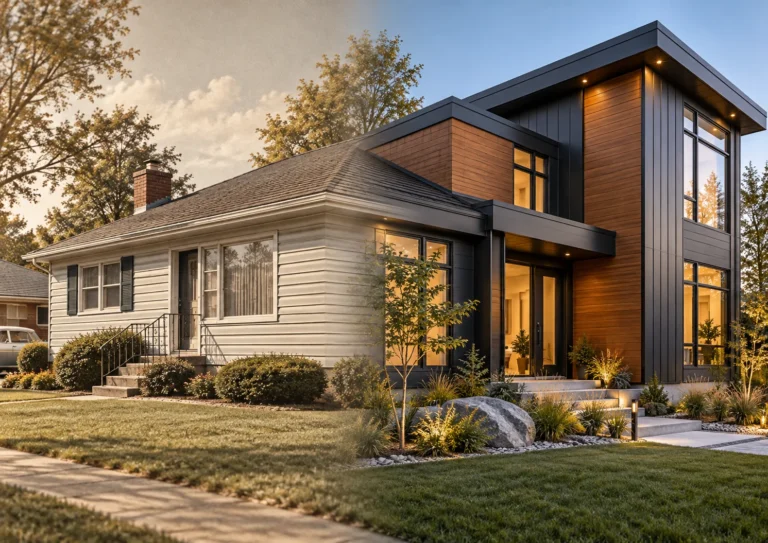
They should not automatically be applied to every modern aluminum product. Aluminum siding manufacturing has evolved significantly.
Our article on the history and evolution of modern aluminum siding explains this transition in more detail.
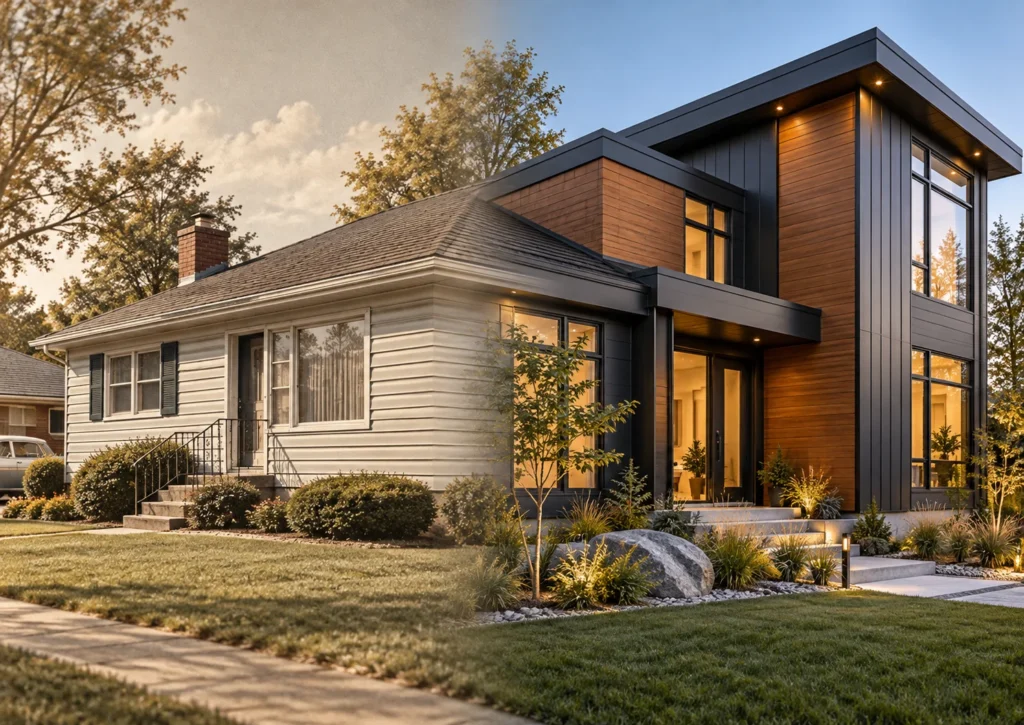
Traditional Aluminum vs Modern Extruded Aluminum
VEDREX siding is manufactured from 6063-T6 architectural aluminum using an extrusion process.
Instead of taking a thin sheet and bending it into shape, aluminum is pushed through a precision die that creates the complete cross-section of the profile.
For example, VEDREX 4-inch and 6-inch V-Groove siding uses a 1.6 mm profile thickness, with lengths available up to 19 feet.
That construction produces a substantially different product from conventional lightweight aluminum lap siding.
Modern extruded profiles can provide:
- greater rigidity
- better resistance to normal everyday impacts
- precisely controlled geometry
- long architectural lines
- concealed attachment systems
- horizontal or vertical installation
- modern V-Groove profiles
- corrugated profiles
- solid architectural colours
- realistic woodgrain finishes
So when comparing modern aluminum siding vs steel siding, old residential aluminum should not be used as the benchmark.
Steel Siding: What Is It Made From?
Steel siding usually starts with sheet steel.
Because ordinary carbon steel can corrode when exposed to moisture and oxygen, exterior steel siding generally relies on a protective system around the underlying steel.
Depending on the product, this can involve:
- zinc-coated galvanized steel
- aluminum-zinc alloy-coated steel
- primer
- factory-applied paint or organic coating
- multiple protective layers
Canada has specific industry guidance for these systems. The Canadian Sheet Steel Building Institute’s CSSBI 23M Standard for Residential Steel Cladding, for example, addresses metallic-coated and prefinished sheet steel intended for exterior siding, soffit and fascia applications.
Good steel siding is therefore not simply exposed raw steel.
Its durability depends heavily on the steel gauge, metallic coating, paint system, fabrication, detailing and installation.
Aluminum vs Steel Siding for Corrosion and Rust
This is one of the most important differences between the two materials.
Does Aluminum Siding Rust?
No.
Aluminum does not contain the iron necessary to create the familiar red-brown iron oxide we call rust.
When bare aluminum is exposed to oxygen, it rapidly develops a very thin oxide layer on its surface. This oxide layer generally helps protect the underlying aluminum.
The Aluminum Association identifies aluminum as a lightweight, durable, and corrosion-resistant building material and discusses its use in modern construction in its building and construction resources.
However, saying that aluminum doesn’t rust is not the same as saying aluminum can never corrode.
Aluminum can experience localized corrosion, including pitting, under aggressive exposure conditions. Chlorides from coastal environments and winter road salt can be particularly relevant.
We explain this in detail in our guide to aluminum siding oxidation and corrosion resistance.
Good aluminum façade design therefore still requires:
- proper drainage
- compatible fasteners
- appropriate material separation
- correct flashing
- protection of the finish
- proper cleaning where heavy salt contamination occurs
Can Steel Siding Rust?
Steel siding can provide very good corrosion resistance because exterior steel is normally protected by metallic coatings and paint systems.
Galvanized coatings are especially effective because zinc does more than simply create a physical barrier. It can also provide sacrificial protection to the steel.
This means a small scratch does not automatically mean that a steel façade will immediately begin visibly rusting.
However, steel fundamentally relies on protecting a ferrous substrate.
If protective coatings are sufficiently damaged, deteriorated, or consumed over time, the exposed steel substrate can eventually corrode.
This difference becomes important at:
- damaged surfaces
- exposed cut edges
- improperly treated penetrations
- areas exposed continuously to moisture
- locations repeatedly contaminated by salt
- poorly drained details
Which Is Better for Canadian Conditions?
For buildings exposed to snow, rain, freeze-thaw cycles, road-salt spray, and seasonal humidity, aluminum has an inherent advantage because there is no carbon-steel core capable of developing red rust.
That does not make properly coated steel unsuitable for Canada.
It simply means steel’s corrosion resistance depends more directly on preserving its protective coating system.
Steel vs Aluminum Siding in Canadian Winters
Canadian exterior walls experience considerably more than cold temperatures.
A siding system may face:
- temperatures below freezing
- rapid temperature changes
- snow accumulation
- melting snow
- wind-driven rain
- freeze-thaw cycling
- summer heat
- UV exposure
- road salt and chloride contamination
- repeated wetting and drying
Neither aluminum nor steel absorbs water like wood.
Neither rots.
Neither becomes brittle in cold weather in the way some plastic materials can.
Both therefore have good fundamental characteristics for Canadian façades.
The Bigger Issue Is the Wall Assembly
Siding itself is only the exterior layer.
Behind it, the building still needs to manage:
- water
- drainage
- ventilation
- air leakage
- vapour
- insulation
- thermal bridging
- flashing around penetrations and openings
A high-quality metal panel installed over a badly designed wall is still a badly designed wall.
VEDREX aluminum siding is designed to work as part of a rainscreen assembly, allowing water that passes the outer cladding to drain and helping air move behind the façade.
The latest national model requirements can be reviewed through the National Research Council’s National Building Code of Canada 2025.
Always remember that the applicable building code depends on the province, territory, municipality, building type and project date. National model codes should not be treated as a substitute for checking the requirements adopted in your jurisdiction.
Which Is Stronger: Steel or Aluminum Siding?
This question needs qualification.
At the material level, steel generally has greater strength and stiffness than aluminum.
But siding performance is not determined by raw material alone.
Consider two hypothetical products:
- a thin roll-formed steel sheet
- a substantially thicker, engineered extruded aluminum profile
Simply knowing that one is steel and the other is aluminum does not tell you which finished profile will better resist a particular impact or remain flatter across a façade.
Panel geometry matters.
So do:
- material thickness
- alloy or steel grade
- rib geometry
- unsupported span
- fastening
- substrate alignment
- panel width
Where Steel Has an Advantage
High-quality heavier-gauge steel can be an excellent choice where severe impact resistance is a dominant concern.
This can be relevant for certain:
- industrial buildings
- agricultural structures
- utility buildings
- high-abuse areas
Where Extruded Aluminum Changes the Comparison
One of the historical criticisms of aluminum siding was denting.
That criticism is much more relevant to thin sheet aluminum than to a substantial architectural extrusion.
VEDREX’s 1.6 mm extruded profiles have considerably more material and rigidity than traditional lightweight aluminum lap siding.
For normal residential and commercial façade exposure, that creates a very different level of robustness from the aluminum many people remember from older homes.
What About Oil Canning?
Oil canning is the visible waviness sometimes seen in flat metal roofing and wall panels.
Importantly, oil canning is not exclusively an aluminum problem or a steel problem.
It can occur in:
- steel
- aluminum
- zinc
- copper
Factors include:
- panel width
- metal thickness
- profile geometry
- manufacturing stresses
- thermal movement
- substrate alignment
- fastening
- installation
Broader, flatter and thinner metal surfaces tend to make visible waviness more noticeable.
This is one reason VEDREX’s relatively narrow extruded plank geometry behaves differently from large flat sheet-metal panels.
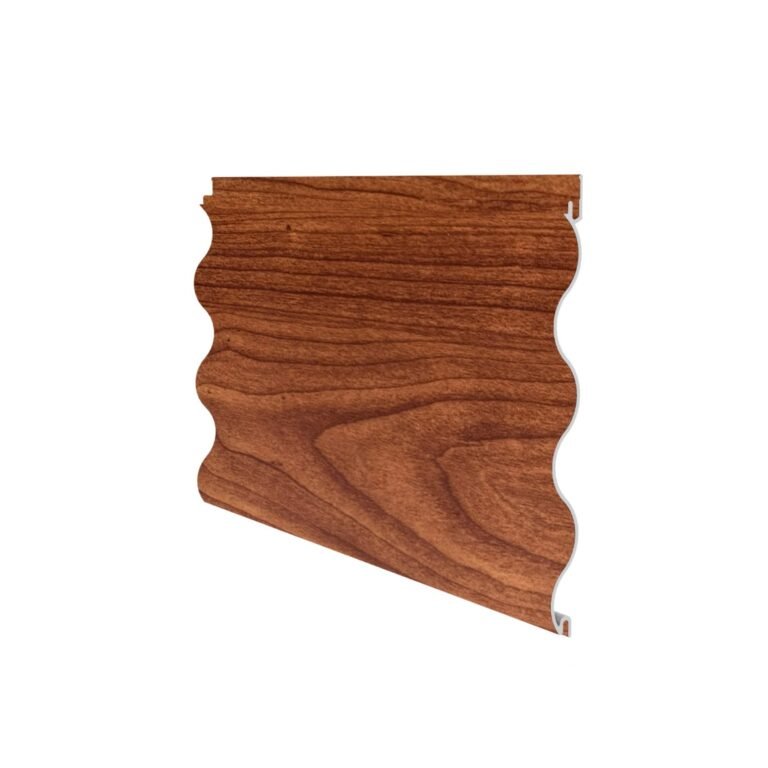
If you prefer a more textured façade, the VEDREX corrugated aluminum siding profile also uses repeating ribs that break up large flat surfaces and create stronger shadow lines.
Aluminum vs Steel Siding Weight
One of aluminum’s most useful construction properties is its low density.
Aluminum is roughly one-third the density of steel.
That does not mean every finished aluminum siding panel weighs exactly one-third as much as every steel panel, because the two products may have completely different:
- thicknesses
- profiles
- dimensions
- reinforcements
But it does explain why aluminum is widely used when engineers and designers want useful strength without unnecessary weight.
Why Lower Weight Matters During Installation
Lighter components can make it easier to:
- unload materials
- move profiles around the project
- carry long lengths
- position panels on scaffolding
- work around upper elevations
- reduce physical handling demands
This can become increasingly relevant on long profiles and multi-storey façades.
Steel remains entirely practical to install, but equivalent panel sizes are generally heavier.
Cutting and Installation: Steel vs Aluminum Siding
Neither material should be installed as though it were vinyl siding.
Both require tools, fasteners, and techniques appropriate for metal façades.
Installing Steel Siding
The exact process depends on panel design and gauge.
Steel siding may require:
- appropriate metal-cutting equipment
- corrosion-resistant fasteners
- careful treatment of cut edges
- correct panel alignment
- accommodation for thermal movement
- manufacturer-approved trims and flashings
The additional weight of steel may also affect material handling on larger panels.
Installing VEDREX Aluminum Siding
VEDREX siding uses engineered extruded profiles, trims and mounting components.
Depending on the configuration, installation includes:
- establishing an appropriate substrate or furring system
- installing starter and corner profiles
- cutting extrusions with tools suitable for non-ferrous metal
- attaching the engineered mounting clips
- maintaining correct clearances
- allowing profiles to move with thermal expansion
- integrating flashing and drainage details
For the complete process, see our aluminum siding installation guide.
The lower weight of aluminum helps with handling, but architectural aluminum is still a professional façade product. Installation quality matters just as much as material quality.
Thermal Expansion: Does Aluminum Move More Than Steel?
Yes. Aluminum has a higher coefficient of thermal expansion than steel.
That means an equivalent length of aluminum generally undergoes greater dimensional movement for the same temperature change.
This is a real design consideration in Canada because façades can experience substantial seasonal and daily temperature changes.
It is not automatically a disadvantage when the system is engineered for it.
VEDREX profiles and attachment details are designed so that thermal movement can be accommodated rather than restraining every panel rigidly.
Incorrectly fastening metal siding can create problems regardless of whether the siding is aluminum or steel.
The important question is not:
Does the material move?
Every building material moves.
The useful question is:
Has the siding system been designed and installed to accommodate that movement?
Steel vs Aluminum Siding Colours and Finishes
Both materials can be supplied in attractive architectural finishes.
Steel siding commonly comes in a wide range of factory-painted colours, making it easy to coordinate with roofing, doors, trim and other exterior elements.
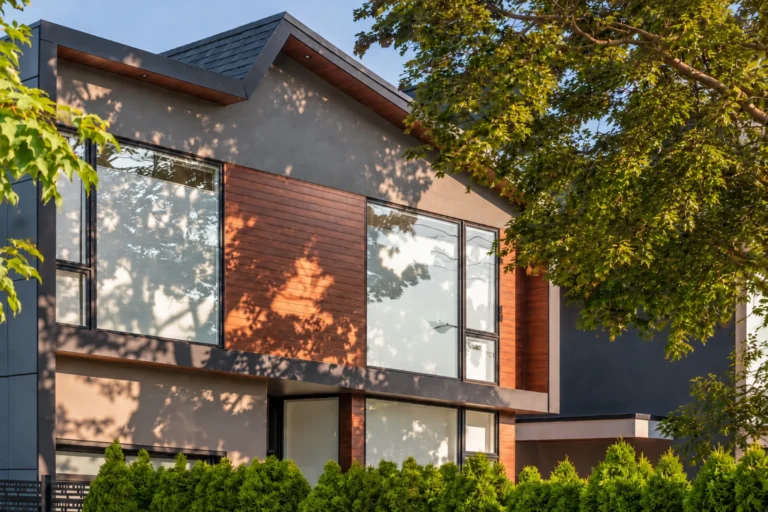
Modern architectural aluminum expands the design possibilities further.
VEDREX currently offers:
- more than 20 woodgrain finishes
- solid colours
- metallic finishes
- custom finish options
Examples include:
- Charcoal Gray
- Arctic White
- Sea Shell White
- Charcoal Slate
- Anodized Silver
- Statuary Bronze
- Coastal Blue
- Walnut
- Golden Oak
- Light Cedar
- Natural Oak
- Red Cedar
- Olive Wood
- Kwila
You can explore the complete VEDREX aluminum siding colour and woodgrain finish collection.
Woodgrain Aluminum vs Wood-Look Steel
Both technologies can reproduce a wood-inspired appearance depending on the manufacturer.
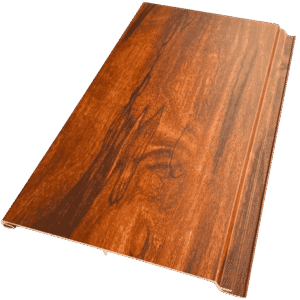
VEDREX uses powder coating and sublimation technology to create woodgrain patterns over extruded aluminum.
This gives architects and homeowners a way to combine:
- the visual warmth of wood
- long linear profiles
- low maintenance
- rot resistance
- non-combustible metal construction
For projects where natural-looking wood textures are a major design objective, modern architectural aluminum becomes particularly competitive.
Vertical and Horizontal Installation
Traditional steel and aluminum siding were strongly associated with horizontal installation.
Modern architecture has moved beyond that limitation.
VEDREX profiles can be incorporated into designs using:
- horizontal layouts
- vertical layouts
- mixed orientations
- accent volumes
- entrance features
- gables
- full façades
Vertical siding can be particularly effective when the intention is to visually increase building height or emphasize an entrance or gable.
See our guide to vertical aluminum siding panels for design and installation considerations.
Aluminum vs Steel Siding Maintenance
Both materials can be relatively low maintenance.
Aluminum Siding Maintenance
For a modern coated aluminum system, routine maintenance generally focuses on keeping the surface clean and periodically checking:
- joints
- flashings
- sealants where applicable
- damaged areas
- fasteners
- areas exposed to heavy salt deposits
Aluminum does not need protection from red rust.
If the finish is damaged, however, it should still be inspected and repaired according to the manufacturer’s recommendations.
Steel Siding Maintenance
High-quality coated steel also requires relatively little routine maintenance.
However, owners should pay particular attention to:
- coating damage
- exposed edges
- deep scratches
- fasteners
- penetrations
- corrosion around damaged sections
- areas repeatedly exposed to moisture or salt
Well-maintained steel siding can perform for decades.
Which Siding Lasts Longer: Steel or Aluminum?
There is no technically responsible universal number.
Both high-quality aluminum and steel building products can remain in service for multiple decades.
Actual lifespan depends on:
- alloy or steel specification
- profile thickness or gauge
- coating system
- UV exposure
- salt exposure
- pollution
- building orientation
- installation
- drainage
- maintenance
- physical damage
It is therefore better to compare specific systems and warranties than to assume every aluminum product lasts longer than every steel product, or vice versa.
Architectural aluminum does have one useful long-term characteristic: even if its decorative coating eventually becomes damaged, there is no hidden carbon-steel substrate underneath waiting to develop red rust.
Steel and Aluminum Siding Standards
Standards are another area where broad marketing claims should be treated carefully.
There is no single universal test that proves one siding material is simply “better.”
Different standards evaluate different parts of the system.
Steel Siding Standards
For Canadian residential applications, CSSBI publishes requirements addressing prefinished metallic-coated sheet steel siding.
These cover areas such as:
- steel properties
- material thickness
- metallic coatings
- exterior coating performance
- loading
- deflection
- fabrication
- erection
The appropriate specification depends on the building and application.
Aluminum Finish Standards
Architectural aluminum finishes are often evaluated using specifications such as AAMA 2604 and AAMA 2605.
These deal with performance characteristics of organic coatings used on architectural aluminum.
Depending on the specification and testing program, characteristics may include:
- adhesion
- colour retention
- gloss retention
- humidity resistance
- corrosion resistance
- chalking
- weathering
Building Code Compliance Is About the Assembly
Neither an aluminum alloy designation nor a steel coating specification by itself establishes that an entire wall assembly complies with every building-code requirement.
The complete design may need to consider:
- cladding attachment
- wind loads
- precipitation control
- drainage
- second plane of protection
- fire performance
- flashing
- air and vapour control
- insulation
- local building conditions
Always use the applicable provincial or territorial code, project specifications, manufacturer documentation and professional design requirements.
Sustainability: Aluminum vs Steel
Both metals have significant recycling infrastructure and can be recycled rather than treated as disposable façade materials.
Aluminum has an especially strong circular-material advantage because it can be repeatedly recycled while retaining useful material properties.
Steel is also one of the world’s most extensively recycled materials.
From a sustainability perspective, a more complete comparison should therefore consider:
- recycled content
- manufacturing energy
- transportation
- product weight
- service life
- maintenance requirements
- replacement frequency
- end-of-life recyclability
Choosing a façade expected to remain in service for decades can often be more meaningful than evaluating only one sustainability metric.
Aluminum Siding vs Steel Siding Cost
There is no meaningful single price for either material.
Steel siding ranges from relatively economical roll-formed products to sophisticated architectural systems.
Aluminum does too.
VEDREX extruded aluminum belongs to the premium architectural siding category rather than the economy replacement-siding market.
Initial Material Cost
Basic steel siding may have a lower initial material cost than premium extruded aluminum.
That can make steel particularly attractive for:
- large utility structures
- agricultural buildings
- cost-sensitive commercial projects
- applications where large simple wall areas need economical coverage
Premium architectural steel can move much closer to aluminum depending on gauge, profile and finish.
Installation Cost
Aluminum’s lower weight can simplify handling, particularly when long profiles are involved.
Steel installation cost may be influenced by:
- heavier material
- cutting requirements
- panel format
- project height
- crew size
- site access
Aluminum installation has its own technical requirements, so lower weight should not be interpreted as automatically guaranteeing lower labour cost.
Long-Term Cost
Lifecycle comparisons should include more than the invoice for the siding itself.
Consider:
- installation
- maintenance
- finish repair
- corrosion management
- damaged panel replacement
- expected service life
- access costs for future repairs
On a premium residential or commercial building, spending more initially on the façade can make sense if it improves appearance, simplifies maintenance and reduces the likelihood of future replacement.
Pros and Cons of Steel Siding
Advantages of Steel Siding
- Strong material with excellent structural properties
- Good impact resistance with appropriate gauge and profile
- Available in numerous colours and configurations
- Well-established manufacturing industry
- Can provide decades of service when correctly protected
- Suitable for residential, commercial, agricultural and industrial buildings
- Non-combustible metal substrate
- Highly recyclable
- Economy products can offer attractive initial pricing
Disadvantages of Steel Siding
- Heavier than aluminum
- Requires a corrosion-protection system
- Exposed steel can eventually develop red rust if protection is sufficiently compromised
- Cut edges and damaged coatings require appropriate attention
- Large thin flat panels can exhibit oil canning
- Some steel profiles create a more industrial appearance than homeowners want
- Long-term performance depends significantly on metallic and paint coatings
Pros and Cons of Modern Extruded Aluminum Siding
Advantages of Extruded Aluminum
- Cannot develop red iron rust
- Naturally forms a protective oxide layer
- Lightweight relative to steel
- 6063-T6 architectural alloy used by VEDREX
- Rigid extruded profile construction
- Suitable for long architectural profiles
- Solid, metallic and realistic woodgrain finishes
- Horizontal and vertical design possibilities
- Low routine maintenance
- Non-combustible metal construction
- Highly recyclable
- Well suited to modern residential and commercial architecture
- Particularly useful where corrosion resistance and premium aesthetics are important
Disadvantages of Extruded Aluminum
- Premium systems generally have a higher initial cost than economy steel siding
- Aluminum has greater thermal expansion than steel, so attachment and clearances must be correctly engineered
- Aluminum can still experience localized corrosion under aggressive conditions
- Severe impacts can still damage a profile
- Requires appropriate non-ferrous cutting techniques
- Architectural extrusions cannot simply be bent on site like some thin sheet products
- Correct trims and accessories need to be planned before installation
So Which Is Better: Aluminum Siding or Steel Siding?
There is no universal winner for every building.
Steel siding can be an excellent option when strength, economy, large-format coverage or industrial/agricultural applications are primary considerations.
High-quality coated steel can provide decades of performance in Canadian environments when correctly specified, installed and maintained.
But for many contemporary residential, institutional and commercial projects, modern extruded aluminum has several important advantages.
VEDREX aluminum siding offers:
- no red-rust risk
- lightweight construction
- rigid extruded profiles
- premium architectural geometry
- extensive woodgrain and solid-colour options
- horizontal and vertical design flexibility
- low maintenance
- strong compatibility with modern rainscreen construction
Most importantly, it should not be confused with the thin residential aluminum siding installed across North America decades ago.
Modern architectural aluminum is a different product category.
The Bottom Line for Canadian Projects
If you are comparing steel vs aluminum siding for a barn, industrial building or highly cost-sensitive utility structure, coated steel may be the more practical choice.
If you are designing a modern home, custom residence, commercial façade or institutional building where appearance, corrosion resistance, material weight, long-term maintenance and finish quality matter, extruded aluminum deserves serious consideration.
For Ontario projects in particular, the combination of winter moisture, freeze-thaw cycles, road salt, summer humidity and substantial seasonal temperature variation makes material specification and wall detailing especially important.
The choice should therefore go beyond simply asking:
Steel or aluminum?
A better question is:
What profile, alloy or steel grade, coating system, attachment method and wall assembly will give this particular building the appearance and long-term performance it needs?
That is where modern architectural aluminum systems such as VEDREX differ most clearly from both conventional steel siding and the aluminum siding of previous generations.
For another common exterior-material comparison, read our guide to aluminum siding vs vinyl siding for Ontario climates.