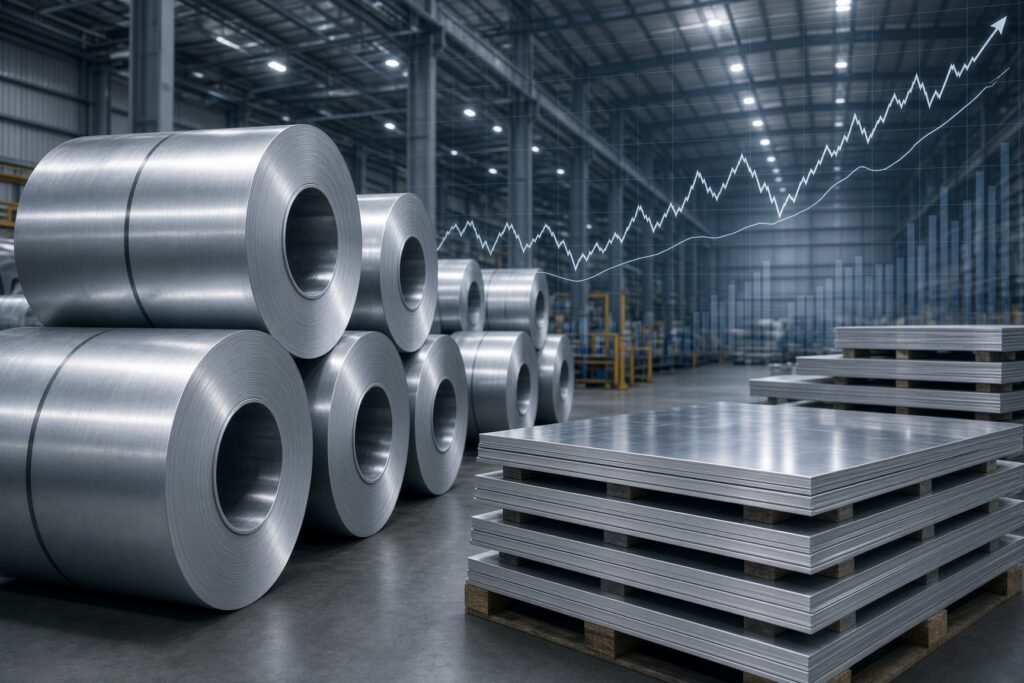
For contractors, the biggest problem with rising aluminum prices is not simply that aluminum costs more.
It is that the price you use to bid a project may not be the price you see when it is time to order the material.
Across Ontario, contractors and estimators are dealing with price-increase notices, changing material costs and continued uncertainty around tariffs and supply chains. That creates a difficult question during every tender:
How much confidence can you put in the number you are carrying today?
In 2026, that question matters more than ever.
The Ontario Construction Secretariat reported that 58% of contractors experienced at least one project delay or cancellation, with escalating material costs cited by 66% of respondents as a contributing factor. Trade uncertainty and financing pressures are adding to the challenge.
For contractors bidding aluminum cladding, soffit and linear systems, supplier pricing has therefore become more than a purchasing issue.
It is a project-risk issue.
Aluminum prices are only part of the story
Aluminum is traded globally, with the London Metal Exchange serving as one of the primary reference points for the industry. On July 28, 2026, the LME official cash price for aluminum was approximately US$3,105 per metric tonne, with the three-month price around US$3,110–$3,112 per tonne.
But contractors do not purchase a tonne of LME aluminum.
They purchase finished products.
A cladding panel, soffit profile, linear batten or architectural extrusion has gone through a much longer manufacturing process before it reaches a jobsite.
The final price can reflect the LME metal value, regional premiums, extrusion billet and alloy costs, extrusion and fabrication, powder coating or other finishing, labour, energy, packaging, transportation, warehousing and manufacturing overhead.
That distinction is important.
When aluminum moves on the LME, the cost of a finished architectural system does not automatically move by exactly the same percentage. Different manufacturers have different purchasing arrangements, manufacturing costs, supply chains and operating structures.
That means two manufacturers can face the same aluminum market and make very different decisions about pricing.
Why construction material costs remain under pressure
Aluminum is not moving in isolation.
Statistics Canada reported that Canadian non-residential building construction costs increased 1.4% in the second quarter of 2026 and were 3.5% higher year over year. Metal fabrications were among the divisions recording the largest quarterly increases, rising 2.0% in non-residential construction. Statistics Canada specifically identified tariffs, supply-chain pressures, fuel and transportation costs as contributors to construction-price increases.
Trade policy has made the situation more complicated.
The United States increased Section 232 tariffs on steel and aluminum in June 2025, and the tariff framework has continued to be adjusted through 2026. Canada has also maintained measures affecting certain U.S. steel and aluminum products while extending tariff relief for some eligible aluminum inputs.
For a contractor, the exact mechanics of every tariff may be less important than the practical result:
There are more variables capable of changing the delivered cost of an aluminum building product than there were in a more stable market.
And every additional variable creates potential exposure between tender, award, shop drawings, release and installation.
The real question is who carries the volatility
When prices are stable, contractors can focus primarily on comparing product, service and installation cost.
When prices are volatile, another consideration becomes equally important:
Who carries the risk if material costs move after the bid?
Some manufacturers respond to market changes by adjusting their price lists. Others shorten quotation-validity periods. Some introduce surcharges or pass increases through as they receive them from upstream suppliers.
Those approaches may be commercially understandable.
But the contractor still has to deal with the consequence.
Imagine bidding a cladding package at one material cost and receiving the project several months later. If the supplier’s price changes before the purchase order is released, the contractor has limited choices:
- Absorb the increase and reduce margin.
- Attempt to pass the increase to the general contractor or owner.
- Value-engineer the system.
- Requote the project.
- Or find another supplier after the project has already been designed and awarded.
None of those is an attractive position.
This is why, in a volatile market, price stability itself has value.
VEDREX has taken a different approach
During the current period of market movement and industry price increases, VEDREX has maintained its existing pricing.
That does not mean the aluminum market has stopped affecting manufacturing costs.
It means we have not automatically turned every short-term movement in the market into another price increase for contractors.
For our customers, the distinction is significant.
A contractor should be able to estimate a cladding, soffit or linear-system package with confidence that the material number being carried is meaningful, not simply a temporary number that may have to be rebuilt by the time the project moves forward.
Our Ontario manufacturing model also keeps more of the production process closer to the projects we serve. That reduces dependence on some of the long international finished-product supply chains where freight, border issues and logistics can introduce additional variables.
The objective is straightforward:
Make the material side of the project more predictable for the contractor.
Stable pricing protects more than the material budget
Consider what happens after a contractor submits a competitive bid.
Labour has been estimated. Equipment has been allocated. Overhead and profit have been calculated. The material package has been priced. The contractor wins the job based on those assumptions.
If a major supplier subsequently increases its price, that increase does not simply appear as another line on a spreadsheet.
It comes directly out of the economics of the project unless the contractor can recover it elsewhere.
That makes predictable material pricing valuable in several ways:
- It protects estimating confidence. An estimator can carry a number with greater confidence instead of building a large contingency into every aluminum package.
- It helps protect margin. Every unexpected material increase after award puts pressure on the profit built into the original tender.
- It reduces unnecessary requoting. Estimators already have enough work without repeatedly rebuilding material packages because a supplier has issued another increase.
- It simplifies conversations with general contractors and owners. Contractors do not want to return after award explaining that a quoted material package has suddenly changed.
- It improves project planning. On projects with longer design, approval and procurement cycles, pricing predictability becomes increasingly valuable.
In other words, stable pricing is not simply about paying less.
It is about carrying less uncertainty.
The lowest product price and the lowest project risk are not always the same thing
During a volatile market, evaluating suppliers only by today’s unit price can be misleading.
A supplier may appear competitive on bid day but expose the contractor to escalation later.
Another supplier may provide greater consistency between tender and procurement.
The difference becomes especially important on larger projects.
A small percentage increase on a significant cladding or soffit package can quickly consume thousands of dollars of expected margin. For contractors operating in an increasingly competitive bidding environment, protecting that margin matters.
The Ontario Construction Secretariat reports that 89% of contractors describe competition as strong, while 34% expect competition to increase further in 2026. More than half of work is being secured through competitive bidding.
In that environment, contractors cannot simply add large contingencies to every tender and remain competitive.
They need suppliers that help reduce the uncertainty behind the number.
What should contractors ask an aluminum-system supplier?
Before carrying a cladding, soffit or linear-system price into a tender, contractors should understand exactly what they are receiving:
- Is the quoted price stable, or could it change before the material is released?
- What circumstances can trigger a price adjustment?
- Is the finished system manufactured locally or dependent on imported finished products?
- How exposed is the supply chain to international freight or cross-border disruption?
- What happens if several months pass between tender and procurement?
- Will the supplier help maintain pricing consistency as the project moves from estimate to award to production?
These questions can be just as important as profile dimensions, colours or price per square foot.
Because once a project has been awarded, uncertainty has a cost.
Why contractors are choosing VEDREX
We manufacture aluminum siding, soffit and linear systems for contractors who need competitive products, but also need confidence in the numbers they are putting into their bids.
In a market where aluminum costs, tariffs, transportation and other manufacturing inputs continue to move, our approach is to provide greater pricing consistency rather than treating every market movement as an automatic reason to send contractors another price-increase notice.
For an estimator, that means a more dependable material number.
For a project manager, it means fewer surprises between award and procurement.
For a construction company, it means less exposure to a variable that can otherwise cut directly into project margin.
And for an owner or general contractor, it means greater budget certainty from the subcontractors carrying our systems.
Aluminum will keep moving. Your project price does not have to move with every headline.
No manufacturer controls the global aluminum market.
LME prices will rise and fall. Tariff policies will change. Energy and transportation costs will move. The construction industry will continue adapting.
The important distinction is how much of that volatility ultimately reaches the contractor.
At VEDREX, we believe contractors should be able to focus on winning and delivering projects rather than constantly recalculating material costs.
That is why pricing stability is an important part of how we work.
If you are currently pricing an aluminum siding, soffit or batten project, send us your drawings or takeoff requirements. We can help you evaluate the system and provide a dependable material price for your bid.